

Powered by RedCircle
“When somebody tells you no, that doesn’t have to be the end of it. There’s always an appeal. There’s always another way around.”
In this captivating episode of Good Life Stories, host Tracy Crowley delves into the remarkable life journey of Sheryl Tullis, a West Point graduate whose path to military service began with an unexpected rejection that ultimately strengthened her resolve. Sheryl’s story demonstrates how life’s setbacks can become the very catalysts that propel us toward our greatest achievements.
Sheryl never initially wanted to attend West Point, viewing it merely as a “fallback option” suggested by her father when college funding seemed uncertain. As the eldest of four children in a single-income military family, she understood the financial realities but wasn’t drawn to military life. However, once she began the rigorous application process, something shifted. The challenge drew her in, and she found herself working harder than ever to meet the academic, physical, and leadership requirements.
Everything seemed to be falling into place—academic qualifications, leadership credentials, letters of recommendation, congressional nomination—until the final hurdle: medical qualification. West Point regulations prohibited admission for anyone missing more than one knuckle or phalange, and Sheryl was missing three finger joints from a traumatic childhood accident.
At age nine, while mowing grass on a Sears riding lawnmower after Florida’s summer monsoon rains, Sheryl had reached into the chute to clear wet, sticky grass and severed three fingers. The injury required eight or nine surgeries, including innovative reconstruction where doctors moved the tip of her middle finger to create a functional index finger. During her recovery, when her plastic surgeon commented that “she probably isn’t going to have the dexterity to play piano again,” nine-year-old Sheryl’s response was immediate: “What do you mean I can’t play piano?”
This childhood defiance proved prophetic. Sheryl had been reluctantly taking piano lessons for years, preferring outdoor activities to practice sessions. But hearing she might never play again ignited a fierce determination. She practiced in secret, worked with prosthetic devices her mechanically gifted mother created, and eventually returned to her piano teacher, who “cried and took me back as a student.” From that point forward, she “loved playing the piano because it was my choice and because I’d worked so hard to get there.”
Years later, when West Point rejected her medical qualification, that same piano teacher became her unlikely advocate. His letter to the academy, stating “she plays competition piano. I’m sure she has the dexterity and strength to pull a trigger for you or whatever else you need from her,” secured the waiver that changed her life. As Sheryl reflects, “when somebody tells you no, that doesn’t have to be the end of it. There’s always an appeal. There’s always another way around.”
Her West Point experience as one of the first decade of women graduates brought its own challenges. With women comprising only about 10% of the corps (compared to 25% today), the expectation was to “cut off our hair, lower our voices, and be like one of the guys.” Women couldn’t help other women—they had to fit in with the male cadets. This isolation created lasting impacts that Sheryl didn’t fully understand until years later at a reunion.
The episode’s second half focuses on an extraordinary opportunity that shaped Sheryl’s understanding of leadership: serving as intern speechwriter for General Colin Powell. English professor Major Regina Largent broke protocol to recommend Sheryl for this position typically reserved for English majors. “That’s such a great example of a woman advocating for a younger woman to bring her along that I didn’t recognize until much later in my career,” Sheryl acknowledges.
Working directly with the four-star general provided masterclasses in leadership and culture creation. From learning that “culture really does get set at the top” during a memorable van ride where her humorous comment about a tattoo billboard broke the formal silence, to witnessing Powell’s personal touches like writing thank-you notes to her grandmother for a homemade cake, Sheryl observed leadership principles that would guide her throughout her career.
Powell’s office displayed a framed quote from Abraham Lincoln: “I can make a Brigadier General in five minutes, but it’s not easy to replace 100 horses”—a reminder that true leadership focuses on taking care of people, not position. As Sheryl learned through speechwriting, “it’s never about my brilliant work. It’s about making that person come alive and making sure that their vision and their voice are heard.”
About Sheryl Tullis
Sheryl Tullis is known for challenging boundaries.
She graduated from West Point in the first decade of women graduates. While a cadet, she qualified Airborne and interned as a speechwriter for General Colin Powell. Her first assignment as an Army officer was Deputy Director of Information Management in Germany, during the early days of the world wide web. A few years later Sheryl pioneered Procter & Gamble’s first e-commerce business. At Microsoft, Sheryl served as chief of staff and speechwriter for the Chief Marketing Officer, and created new digital marketing capabilities for 7700 marketers.
Excited by emerging tech, she leapt to exec positions on the mobile agency side — earning 11 industry awards in two years. An advocate for helping others smash ceilings and break boundaries, Sheryl founded Women in Wireless – Seattle and Mobile Mixers, and she earned the Mobile Growth Summit / Bolden “People’s Choice” award for her work as global president of the non-profit which champions women in digital.
Sheryl then joined a private equity firm and rose to Partner and Chief Marketing Officer. A strong proponent of military veteran hiring, she helped pioneer the Microsoft Software and Systems Academy, the first tech transition program for transitioning service members.
Last year she left the corporate world to co-found The Line Experience, with a goal of breaking down barriers to cycling and more inclusive access to public lands. The Line Experience provides affordable mountain, gravel, and e-bike rentals; instruction, and trail guidance, with a particular focus on newer riders of all ages and backgrounds.
- Website: https://thenextstage.co/ | https://theline.bike
- LinkedIn: https://linkedin.com/in/sheryl
- Instagram: https://instagram.com/thelinebike
About Tracy Crowley
Tracy Crowley has always been an entrepreneur. Whether it was making gowns for fellow Army wives, taking portraits in black and white, or working on her other businesses, she is always learning something new.
That passion for learning something new and giving something back collide nicely in this podcast.
Join Tracy for Good Life Stories, where simple curiosity brings out great stories, every single time.
Check out Tracy’s new book! https://tracycrowley.life/
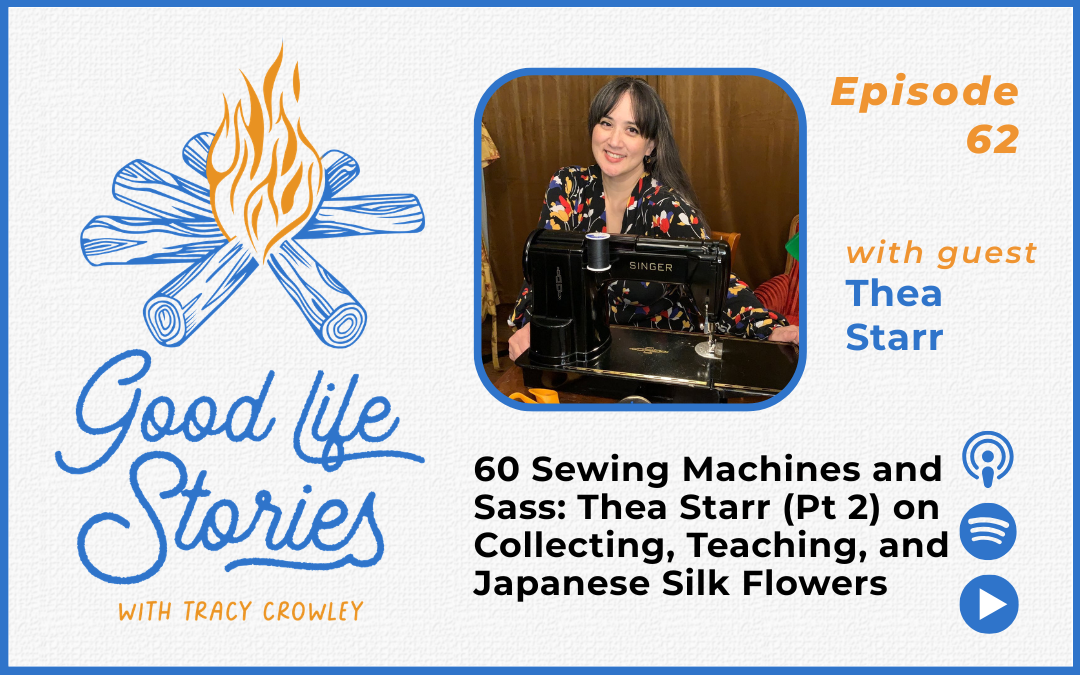
60 Sewing Machines and Sass: Thea Starr (Pt 2) on Collecting, Teaching, and Japanese Silk Flowers
"Every morning I wake up, I brush my teeth, and I sharpen my tongue." ~ Dorothy Parker Thea Starr's favorite Dorothy Parker quote perfectly captures her sass as the youngest of six children. "I'm not a quiet girl," she says. "Nothing's happening for me unless I say...
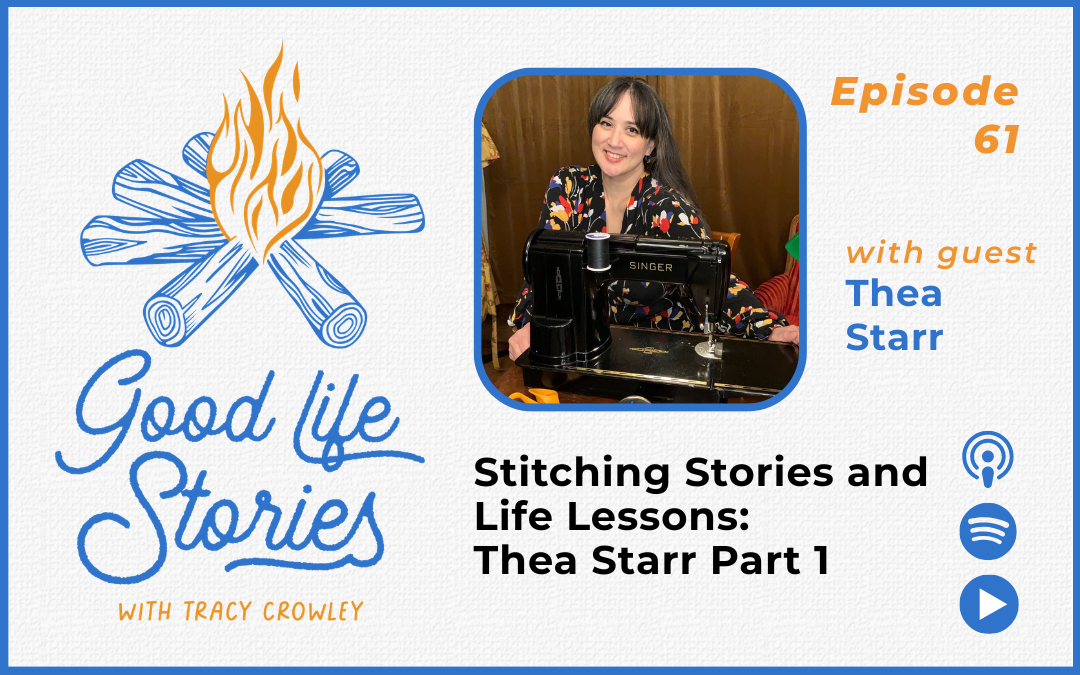
Stitching Stories and Life Lessons: Thea Starr Part 1
Thea Starr describes herself as "a lady in a workshop in the woods at the edge of a bog." She's a sewist, vintage sewing machine repairess, and designer. But before all that, she was "a wild girl. A teenage mom. I even went to juvenile detention. You know, bad girl....

Reinventing Life in the Woods: The Mushroom Foraging Journey with Angela Shen Pt 2
Angela Shen had always been "one of those weird kids that actually liked eating mushrooms." Her dad's a chef, culinary mushrooms were a constant, but she'd never foraged for wild ones herself. Then COVID hit. Everyone was cooped up indoors. "The only access or freedom...

